

42. This Cannot Go On
On shame, stories, and daring to imagine another way

*A gentle note before you read: this piece includes mention of sexual assault and childhood sexual abuse. If you’re feeling tender today, please take care of yourself <3
Beloved readers of TC,
This feels like an activated time. I am feeling so many things at once, and I know I am not alone in that.
I have a natural inclination to write about what is happening in the world and how it is changing me and us. But lately, as the relentlessness of the horrors intensifies, my body and my brain have not been working in cohesion. I keep searching for the “right” words, but what are the “right” words when the floodgates of our darkest underbellies seem to continue coming into the light all at once? How do we make sense of what is senseless without pretending it is not?
One of the few lifelines keeping me going right now has been a writing group I joined for the month of February, hosted by journalist Noor Tagouri and writer Sophie Strand. I have been a longtime fan of Sophie Strand’s work. It humbles me in such a beautiful way and lovingly illuminates how I think in binary terms. Sophie reminds me there are so many other timelines, other kinds of intelligences, other ways life survives — and that we don’t have to hold all of this alone as mere mortals inside a burning system.
During our last class, Sophie offered us a prompt and an invitation to map the story of our lives through non–human encounters. She said she likes to offer this in her writing class because we are often quick to define and map ourselves through the trauma we have experienced. I felt like she was talking straight at me. It made me sad to take note of how quickly I rush to define myself through my pain.
I have never formally learned how to write or been in a writing space before this group. The only reason I started writing was to make sense of this mad world we live in — it was a way to survive — and to this day, I only know how to write from my lived experience. It has to come straight from my belly. Over time, that’s developed into connecting the personal to the larger world. People often tell me they could never share the way I do, that it feels so intimate and vulnerable. Over time, this sense of allowing the world to read me in the messiness of the process has become my superpower.
Sophie then asked us, “When you tell stories, do you have consent from yourself?”
I had to stop myself and really think about that. Did I always have my own consent to share my story?
When I write, it usually starts in my body, a rush of energy in my chest, a lump in my throat, something that has to come out. Sometimes I’ll sit with a piece for years. Other times it has to come out immediately. Over time I’ve learned to trust that strong sense in my body of when something is ready, what needs to be shared, what feels bigger than just mine. I have learned, in an embodied way, how storytelling can liberate and empower me, so that through writing I am no longer a victim of my own stories.
And yet, to this day, one of the few things I have been hesitant to write about has been my experiences of sexual abuse.
My concerns have always been the same. What happens after sharing? There are two vulnerabilities here: the violence itself and the exposure of naming it in a culture that does not know how to respond, that circulates stories of harm but rarely builds structures of repair. I don’t think I have ever witnessed what real accountability or justice looks and feels like.
Tarana Burke, the activist and creator of #MeToo, has always said that she started the project as a healing practice, a way for Black women and girls to share their stories and be witnessed, to know they were not alone. Black women are disproportionately affected by sexual violence — studies show they experience some of the highest rates of sexual assault and are often the least believed, the least supported. (And while I'm focusing here on women and girls, sexual violence, of course, affects people of all genders - men, boys, trans and non-binary people carry this trauma too, often with even fewer places to turn for support.) But when it first went viral, I watched the most vulnerable trauma shaped for headlines, for clickbait. The abusers were centred, and while accountability is important, there was no care for the survivors. We see the same pattern now with the files - men talking about them, centring the headlines, the outrage, but almost no discussion about what their responsibility actually is in all of this. The work of picking up the pieces and repairing is always left to women and survivors themselves.
In a recent podcast episode with Prentis Hemphill on Becoming the People (which I recommend you listen to HERE), Tarana spoke about the fervour around demanding the files be released. Her question stopped me cold: What matters more? The list of names or actually caring for the survivors? If we’re not addressing the systems that enabled the violence, getting to say “gotcha” changes nothing. Survivors become political tools, useful when convenient, discarded when not.

I read a haunting passage in Alexander Chee’s incredible book How To Write An Autobiographical Novel. He was writing about his experience of childhood sexual abuse and said that people misunderstand what sexual violence does. It’s not something taken from you; it’s something put in you that grows and grows and grows. That thing is shame.
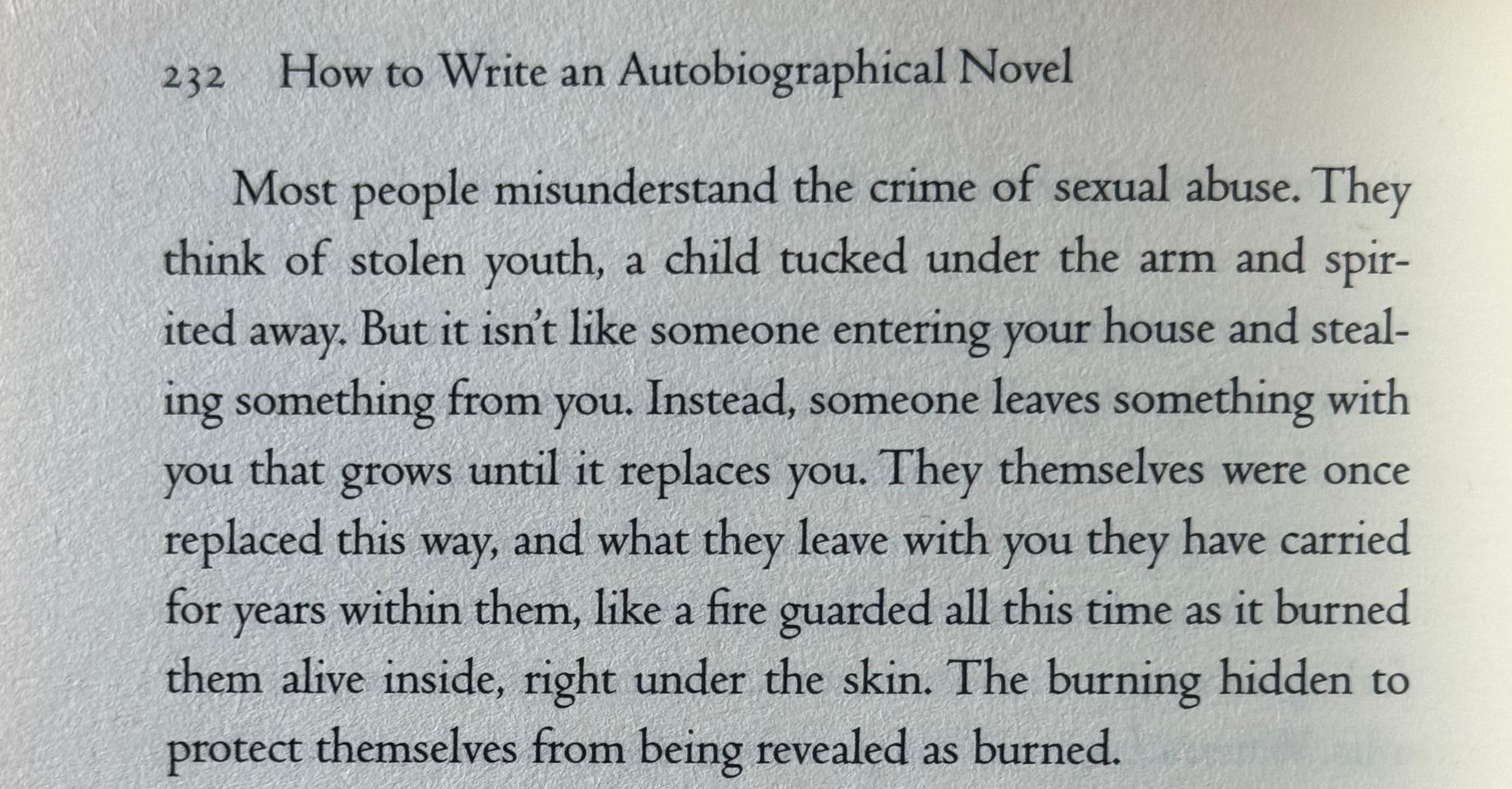
What fascinates me — as someone who has only written first-person non-fiction — is that when Chee first tried to write about his abuse, he couldn’t write it as a memoir; he had to fictionalise it in his first novel because the memories weren’t fully accessible yet. Only later did the memories come back to him in his body. He had to use fiction to untether and work through it. Storytelling as a way to approach what can’t be faced directly. And maybe that’s part of it too: what if we could use fiction and storytelling not just to recount the harm, but to imagine the repair? To write the world we want, the response we deserve?
Tarana talks about how survivors often ask her if they can say Me Too, questioning whether what happened to them “counts”, but she says very clearly that it’s not about the actual facts of what happened to you. It’s about what it left you with, and that if you’re standing there saying you were traumatised by the experience, that is what makes you a survivor.
Shame feels so personal, so intimate, and yet so much of it is systemic. Shame, as therapist David Bedrick writes, is so much more than just a feeling. It is a witnessing framework, a way we learn to see ourselves through eyes that were never meant to hold us. We internalise the gaze of family, culture, gender, race, power, and then turn it inward, policing ourselves from the inside. Shame teaches survival, isolation and how to stay small. The isolation takes us away from ourselves, people we love and the world around us.
It’s enraging and gutting to see how the violence of these narratives created by patriarchy has been internalised within me. The voice that says something is wrong with me all the time. How we measure ourselves against values made up by abusers. We have so much to untangle, our desires, our values, even what success means. The idea of success has been sold to us by the same system that abuses children and abuses the earth. Denial, dehumanisation, and shame are the ultimate tools of domination.
Patriarchy produces violent men, yes, but it also produces boys who learned very early that their tenderness was unsafe, that their needs would not be met, that feeling too much would cost them belonging. These boys left their bodies and hearts before they even had language for what they were leaving. A system that cuts men off from their bodies cannot then magically produce men who know how to stay with rupture, who know how to hold us the way we yearn to be held.
Even with the men I love, men I trusted, when flashbacks from the violence would come, there were so few times I felt met. They did care. It wasn’t cruelty or indifference. They just didn’t have the words or the language for how to be with it, how to meet me in the complexity of it all. I don’t even know what it was I exactly wanted them to say, only that I wanted to feel that I wasn’t alone inside it. We live in a culture where this kind of harm becomes something private, something that lives inside the person it happened to, instead of something shared, reckoned with, and responded to, and so survivors are left to carry their burdens alone.
Tarana talks about how we’re all implicated in different ways - as survivors, as perpetrators, as bystanders, as spectators. What strikes me about her framing is how we often respond so differently to violence depending on the type. When there’s gun violence in a community, however inadequate the response, there’s often at least a collective acknowledgement that this is wrong, that children need protecting. But sexual abuse? Too often, the response is the opposite. A closing in. A scrambling to protect the family, the reputation, the community, which really just means heaping more shame on the child who was harmed.

Now in her nineties, systems scientist and author of the groundbreaking book The Chalice and the Blade, Riane Eisler has spent a lifetime studying archaeological and anthropological evidence. She has arrived at a stark conclusion: we are living through the end of one world, and the possible birth of another, and what happens next depends on the stories we choose to live inside.
Her central insight reframes history itself. According to her research, the real divide is not left versus right, religious versus secular, capitalist versus socialist — it is between domination systems and partnership systems, two fundamentally different ways of organising power. We see this clearly in the files - people across political ideologies, across professions and spheres of influence, united not by shared politics but by their participation in the need for domination. She argues that many societies we’ve labelled “matriarchal” were not female-dominated, but partnership-oriented, structured around mutuality rather than ranking. Eisler identifies four pillars that determine whether a culture tilts toward domination or partnership: how it treats children, how it structures its economy, the stories it tells about human nature, and the systems thinking that links these together. These are not separate issues, but interlocking architectures.
One of her most piercing observations is that violence against children is the seedbed of domination. We see evidence of this everywhere. The ICE abductions of children, separating families, school shootings, the ongoing live-streamed murder and starvation of Palestinian children, child miners in the Congo, grooming gangs and the list of atrocities goes on. This is how we know we live in a domination-based world.
Studies show that the cycle perpetuates itself - many perpetrators of violence were themselves abused as children. Mass shooters overwhelmingly have histories of experiencing or witnessing abuse. This doesn’t excuse the harm they cause, but it shows how domination reproduces itself. Hurt people who never heal hurt other people. The violence gets passed down, generation after generation, until someone breaks the cycle.
But if violence against children is the seed of all domination, then this is also where transformation begins. If we start to address the root, everything shifts. When coercion is normalised at the level of the child, hierarchy is normalised everywhere. If the smallest bodies are ruled through fear, fear becomes the template for power. Look at how a society treats women and children, and you are looking at its governing logic. Real transformation requires shifting childhood relations, gender relations, economic structures and cultural narratives simultaneously.
Tarana frames solvability explicitly as a narrative intervention - it’s really, really important, she says, that we shift the way we even talk about it. We were born into this world to think that this is just it. We raise our girls to expect it as a foregone conclusion, preparing them to protect themselves rather than asking why they have to live like this. She says if you want to solve gun violence, environmental justice, mass incarceration, and police brutality, you have to address sexual and gender-based violence. There’s no way around it. This is a root cause that connects to every other social issue we care about.
One in ten children will experience sexual violence before they turn ten years old. Solvability is about believing - no, knowing - that there are solutions. As Tarana said, “These systems were made by people, so they can be unmade by people.”
As Albert Einstein famously warned, we cannot solve problems with the same thinking that created them. This is a civilizational pivot; it is our turn now. If we’re moving from domination to partnership, we need to rethink our own stories. What would it mean to tell them differently? To tell them from a place of repair, in a world where there are actual repercussions for harm caused, where we’re met with the care we deserve, where protections exist, and lines have been drawn?

In Women Who Run With Wolves, Jungian analyst Clarissa Pinkola Estés writes that stories are medicine. They carry power without asking us to act or change. We only need to listen. Stories, she says, are embedded with instructions for living, for navigating complexity. When people ask what she does in the consulting room, to help women return to their wildish natures, she says she uses the simplest and most accessible ingredient for healing: stories.
In my one-to-one practice, I tell my clients openly that I am not outside of this unravelling. I am another nervous system in the room. The honest thing to say is that I do not have secret tools or polished frameworks that can tidy this moment into coherence. I am living in this same world, shaped by the same forces, moved by the same events. Part of what I do is to witness while supporting people in rewriting their stories. As practitioners, they say we always move towards creating a practice we yearn for ourselves. I’m interested in both softness and rewriting stories because I have needed and continue to need them myself.

Instead of sharing the perfect words of wisdom, here I am sharing from the messiness of the process, sharing my story. Because sexual abuse and shame isolate us in such a way that, for now, I feel like the first step is just knowing we are not alone and trying to find ways in which we can be together. And once we are, maybe we can start dreaming and bringing into existence another way of articulating our lives. A new vocabulary that holds both the harm and the repair, alongside the grief and the possibility.
We are more than the harm done to us. We are a universe. We are also not alone. There are many of us. The trees, the earth, all life-giving beings, our nonhuman kin, who all suffer under domination, are with us too. May there be real justice, real repair. May we be held, supported, witnessed. May we break free from the cage of shame and remember our power.
Another story is possible. The old one must end.

Naomi, thank you always for your tenderness, your willingness to be with us especially at these moments when it feels terrifying to speak because there is so much pain and horror in the air. I'm so grateful for you.
This post really got me, Naomi <3 thank you so much for writing these words. We need them!!!